
Nestlé Bangladesh CSV/Sustainability Initiatives
1. Clean Drinking Water Project:
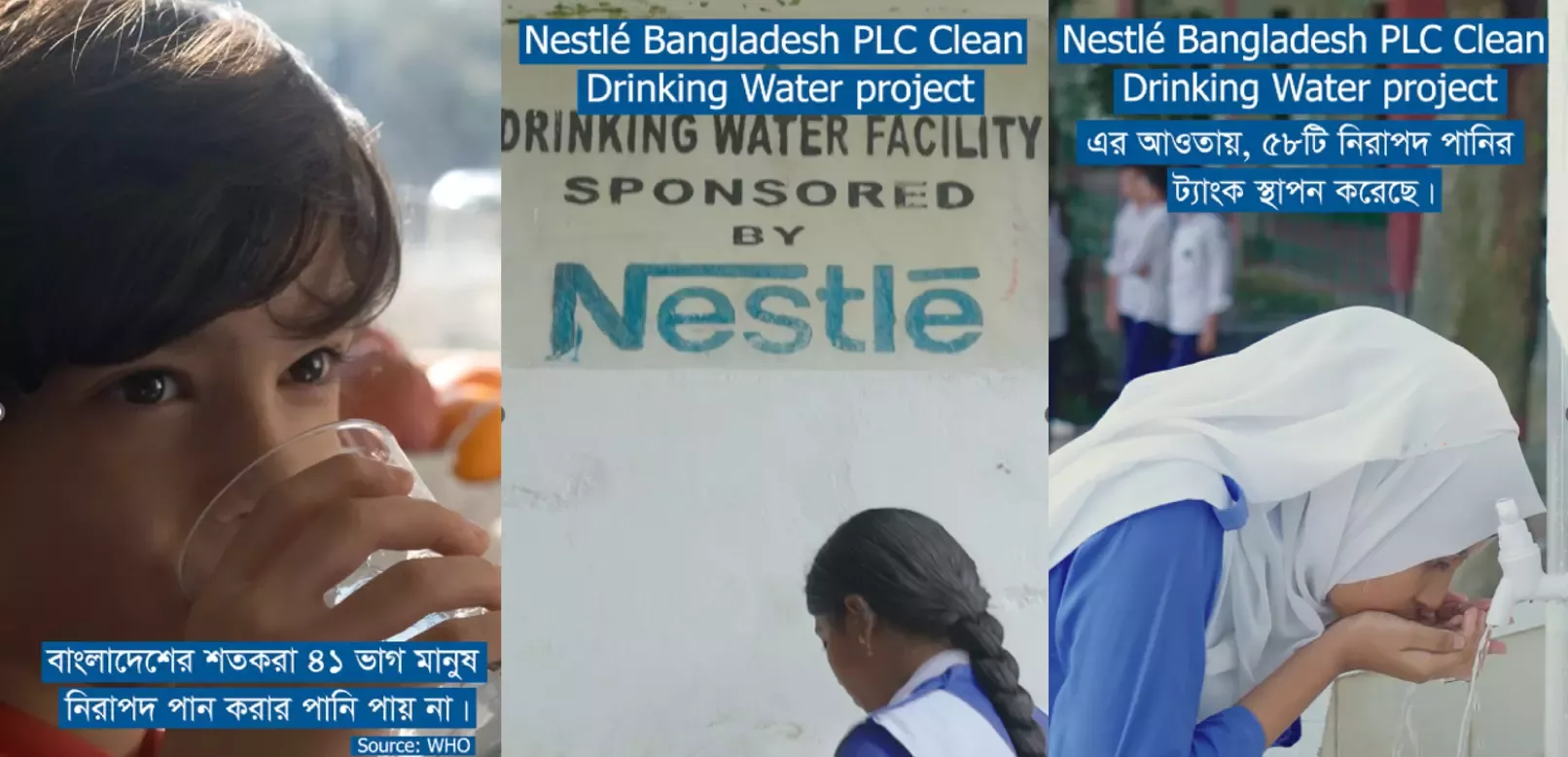
- Access to clean drinking water is a basic human right. However, globally it is also a challenge to source. In many places of Bangladesh, it is one of the luxuries people can’t meet. Safe and clean drinking water has many social, economic, as well as health benefits. People with access to clean drinking water are less prone to diseases like diarrhea, cholera, and other diseases spread by water. Proper sanitation facilities encourage students to attend school and dream of a better tomorrow.
- As a part of Creating Shared Value for society, Nestlé Bangladesh Limited addresses this challenge and builds water tanks and Sanitation facilities for Girls in Gazipur, Bangladesh. We also quarterly maintain and test the water in esteemed labs to ensure that the water is safe for drinking. To date, Nestlé Bangladesh has constructed 58 water tanks benefitting 63, 000 students and communities. In these schools, we also provide water awareness training to help students understand the scarcity and be aware of water waste. So far, 5,300 students have been trained face to face in this awareness program. Nestlé Bangladesh has is also launching the ‘Water Education Program’ in these schools, to have more in-depth awareness and solution-centric education among students about water issues. We have also constructed 39 girls’ sanitation facilities which helped 19,000 female students to remain at school, without the worry about proper sanitation.
- Not only construction, but we also maintain the tanks and test the water quality each quarter to ensure the safety and quality of water. Even when the schools were closed, we continued our maintenance and tests, so that even if single person is having water from the tanks, its safe.
2. Sustainable Sourcing of rice, wheat and spices through enhancing skills of farmers
- Nestlé Bangladesh is committed to responsible sourcing of raw materials, which complies with our global Responsible Sourcing Guideline, to achieve transparency and traceability throughout our supply chains. It is thus an essential part of ensuring a sustainable future, not just for our business, but also for our suppliers, farmers, and producers on whom we rely upon for our operations. It is also an integral part of our commitment to zero carbon emission by 2050.
- As a part of the commitment and with an emphasis on the need and opportunity to source more raw materials locally, Nestlé Bangladesh has taken this project of ‘Connecting farmers for Sustainable Sourcing of Rice, Wheat, Maize and Spice’ where Nestlé trains the farmers in Dinajpur on scientific cultivation of this produces and locally procures from them if they meet the quality standard of Nestlé. Previously all of these raw materials were imported from outside the country, since we wouldn’t get any that would meet our stringent quality standard. This would ultimately increase the carbon footprint in total value chain and no good would be for country’s vast agriculture asset. After we have taken this project, the carbon emission of our products have significantly gone down and more farmers are being benefitted for the training in cultivating quality produces.
- Nestlé Bangladesh has taken several initiatives for sustainable sourcing of this produces and developing local supplier who would meet our stringent quality compliance. These initiatives include:
- The local rice sourcing, with awareness sessions for farmers on fertilizer usage, pesticides usage, and sound irrigation methods, has started from March 2008. Currently, 100% of rice required for our food products is sustainably sourced from local farmers.
- The local honey sourcing has started from 2011 via a partnership with an NGO that specializes in honey collection and processing. The partnership developed local honey vendors and provided training sessions for farmers on bee colony maintenance, honey extraction technique, and hygienic preservation of honey.
- An MOU has been signed in May 2012 with a local spice processor to reduce import of spices and sourcing spice mixes and corn starch locally.
- Partnering with an NGO-based Dairy Industry in 2012 that produces skimmed milk powder (wet mix grade) locally.
- Start of local wheat souring, with training for farmers to reduce the issue of high levels of aluminum in local wheat.
- Start local maize and spice sourcing, similarly, to obtain compliant and high standard maize and spices for our products.
- We have also started to trace the carbon emission that will be reduced when we will successfully achieve 100% sustainable sourcing of rice, wheat, maize, and spices from local farmers. This will have a greater impact on the environment and reduce dependency on imports.
- Several other initiatives to develop more local sourcing of products are also currently under process. Nestlé Bangladesh believes that the well-being of farmers and suppliers is intimately linked with its success.
3. Nestlé for Healthier Kids
- The project initiated in 2010 in collaboration with nutrition expert (late) Dr. Nazrul Islam Khan, Professor, Institute of Nutrition and Food Science, Dhaka University. Together with his expertise, we have built a program that aims classroom training for students aged 13-17 in schools around Gazipur. Every year, around 3000 students of 20-22 schools would enroll in the training program. A book has been developed by the Professor and his team of Nutritionist which is studied in the classrooms in the most fun and interactive way. The book is gifted to each student who are enrolled in the program and the teachers. Before the class begins, the students would go through an evaluation to understand their prior knowledge about nutrition, hygiene, importance of physical activity, etc. After intensive course completion, the students would go through an evaluation again, and graduate from the program after successful completion. They would be called ‘N4HK Graduates’. The program is highly appreciated among educationists and community, as it focuses much on bringing the kids into the journey of leading healthier lives.
- Another extension of N4HK is ‘Knowledge Share Program’. In this program, after graduating from the program, students are handed over simple pamphlets that focuses on nutrition, hygiene, and physical activity in much pictorial forms. The students are asked to share them with their friends, cousins, and parents. This way we ensure that the knowledge is passed to the community and we believe everyone has a role to play in leading healthier lives.
- The project is designed and aimed to bring kids into the discussion of nutrition. It is no surprise that we often hear parents complain about not paying attention to eating healthy foods or not being interested in physical activity. We realize through science that these ultimately hampers the way they grow up. Thus, bringing in kids into the discussion in an early age can help them to decide about their food, while they can make wise decisions of including healthy nutrition in their diet. Thus, we launched over time sub projects like ‘Cooking together’, ‘Choose your food’ etc. to encourage children into food and the ultimate power of food.
- Currently, we are working on launching e-learning module considering the current situation, so that we can spread the goodness of the project across the nation.
4. Water Ambassadorship program
- Preserving water resources is not something one can do alone. Reducing strain on water requires the collaboration of a range of partners, from suppliers to governments and civil society. To address this issue, globally Nestlé has taken multiple initiatives of Environmental Sustainability under the flagship of ‘Roadmap to Net Zero’. As part of the Market initiative, Nestlé Bangladesh has collaborated with House of Volunteers Foundation to build the future generation of the country ready to tackle water issues. Nestlé Bangladesh has entered into an MoU with ‘House of Volunteers’ for a year-long Ambassadorship and Education Program.
- Together, with House of Volunteers we have launched ‘Water Ambassadorship & Education Program’ where experts from prestigious mentors from reputed universities like BUET, have mentored the students on water issues and solutions and prepared them for realistic approaches and design case studies to tackle water issues. After the mentoring sessions, the students went through extensive assessment for ‘Stockholm Junior Water Prize Bangladesh’. The assessment went through various jury panelists and finally two ambassadors were chosen to represent Bangladesh on a national level in the International ‘Stockholm Junior Water Prize’ which is said to be one of the most prestigious award addressing water issues.
- Through out the year, the Water Ambassadorship and Education Program engaged to student community bringing them in mentoring session hosted by water experts of the country. The mentoring sessions were telecasted live in the Facebook which engaged more viewers, majority of them from student community. Throughout the year, various digital contents like videos, posters were shared on Facebook giving bite size information on water issues. As a part of the campaign, quiz competitions were arranged to engage more youth into the interest of water issues. These have created a hype on putting thoughts on Students’ mind about water issues, which is the primary goal of this project. We wanted the young generation to take water issue matter seriously and understand the severity of it, so that they become ambassadors in the future to deal with the issues.
- ‘Water Ambassadorship and Education Program’ has impacted more than what numbers can tell us. 29 Ambassadors were selected in the program from 25 institutes. A total of 5 sessions have been held by experts. The school campaigns were conducted in 4 divisions and 100 volunteers took part in the campaign directly. The social media campaign reached more than 0.45 Million people. 10 districts were totally covered in the program and finally 2 Ambassador won the competition and represented Bangladesh in International ‘Stockholm Water Prize’.
Sustainability Market Initiatives:
1. Zero carbon emission by 2050, half by 2025
2. 100% of packaging recyclable or reusable by 2025
3. Virgin plastic reduced by one third vs 2018 by 2025
4. 20% reduction of water use in manufacturing our products
5. 20% reduction of CO2 emission from Logistics operations
6. 30% carbon neutral procurement
7. Tree Plantation: 1,20, 000 by 2025
8. Advocacy on sustainability (pack labelling, communication, awareness projects etc.)
